


Rising fuel prices: why monitoring your boat’s fuel consumption is now essential
The increase in fuel prices has become one of the most discussed issues for drivers, businesses and families. But there is one sector where the cost of fuel is felt even more strongly: recreational boating.
Anyone who owns a boat, a RIB or an outboard motor knows very well that every trip at sea has a cost. And when the price of petrol rises, even a simple day on the water can become much more expensive than expected.
The problem is not just the price per litre. On a boat, unlike in a car, fuel consumption is not always easy to predict. It depends on many factors: engine type, weight on board, speed, trim, flaps, propeller, sea conditions, wind, hull condition and the way the boat is driven.
This is why knowing the real fuel consumption of your boat is no longer just a technical detail, but a practical tool for saving fuel and money.
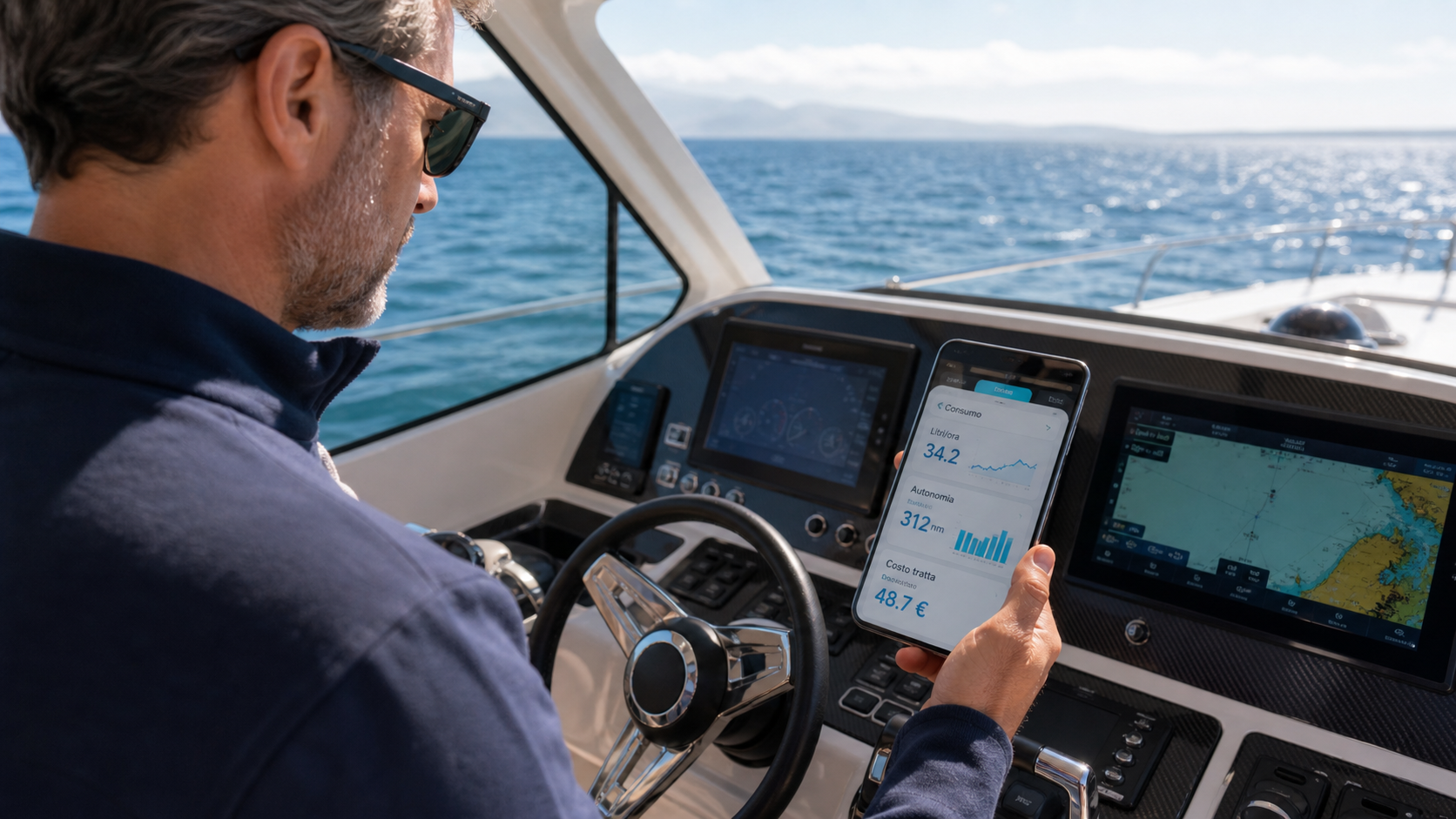
Why have fuel prices increased?
The rise in petrol prices does not depend on a single factor. The final price of fuel is influenced by the cost of crude oil, refining, distribution, taxes, VAT, the euro/dollar exchange rate and international market conditions.
In recent years, however, the geopolitical situation has made energy markets much more unstable. The war between Russia and Ukraine has had a significant impact on European energy markets, changing supply routes and increasing uncertainty around energy, oil and refined products.
This situation has been further complicated by tensions in the Middle East, one of the most sensitive regions in the world for oil production and transport. This does not mean that every increase at the pump is directly caused by a war, but it is clear that conflicts, international tensions and uncertainty over supplies contribute to making fuel prices more unstable.
For boat owners, this instability has a very practical consequence: you cannot control the price of fuel, but you can better control how you consume it.
Rising fuel prices and boating: the real problem is invisible waste
When it comes to boat fuel consumption, many boat owners still rely on rough estimates.
They leave the marina with a full tank, enjoy their trip, return to port and only at the next refuelling do they get a rough idea of how much fuel has been consumed. This method can give a general indication, but it does not show where fuel has been wasted.
The problem is that fuel consumption changes constantly while cruising. A boat may consume much more fuel if:
- the trim is not properly adjusted;
- there is too much weight at the stern or bow;
- the propeller is not suitable;
- the cruising speed is not efficient;
- the hull is dirty;
- the boat is facing head seas;
- the engine rpm is not optimal;
- the boat struggles to stay on plane.
In many cases, the skipper only feels that “the boat is not running well” or that “the engine is working harder”, but does not see the real economic cost of that condition.
This is where rising fuel prices become even more important: if wasting 5 or 10 litres may once have seemed negligible, today it can have a real impact on the cost of every trip.
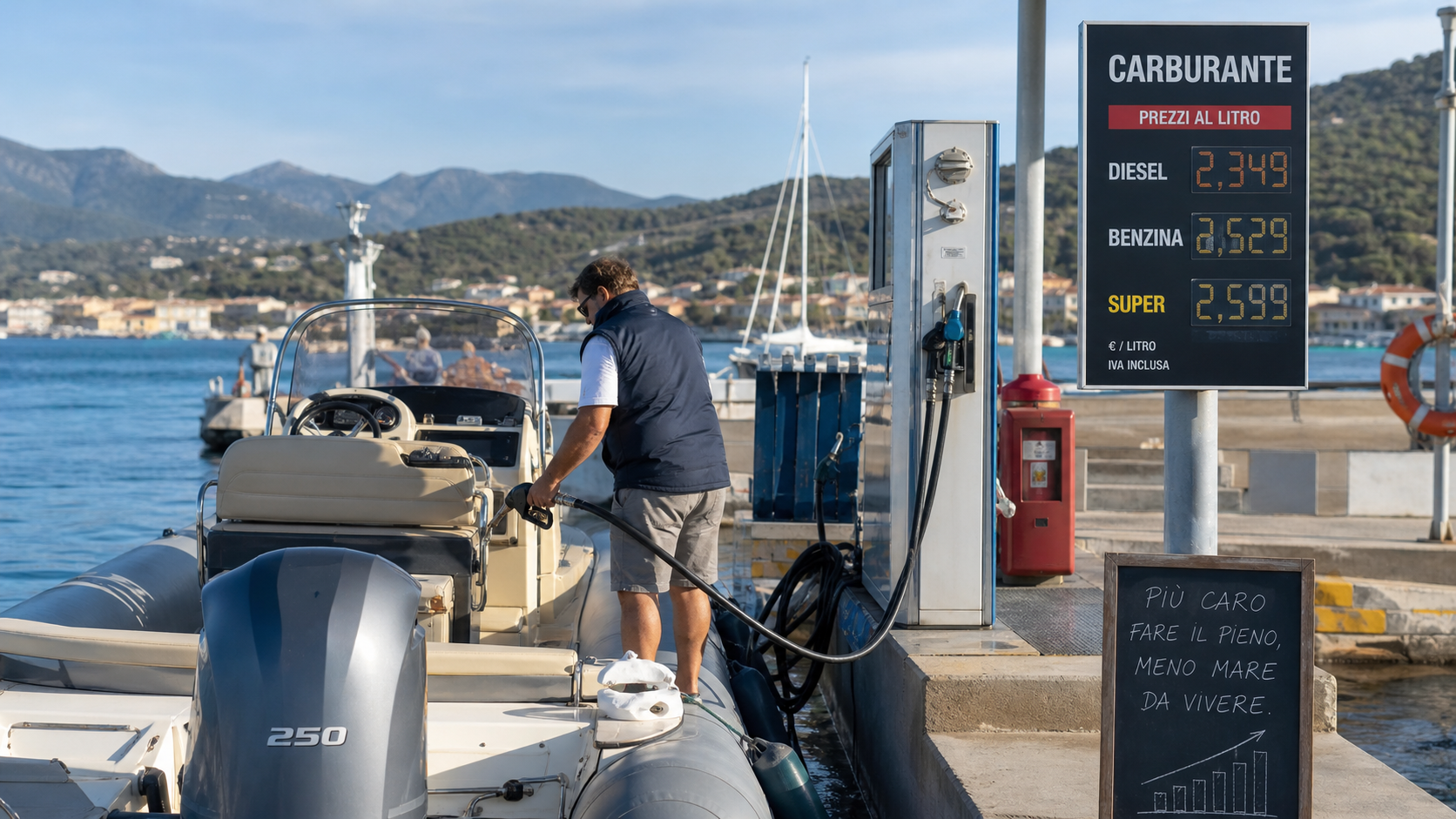
How much can a day on the boat cost with petrol close to 2 euros per litre?
Let’s take a simple example.
Imagine a RIB or a boat with an outboard motor consuming an average of 30 litres per hour while cruising. If the trip involves 3 actual engine hours, the total consumption will be around 90 litres.
With marine petrol close to 2 euros per litre, the cost of fuel alone can approach 180 euros.
If, by better adjusting the boat’s balance, trim and speed, you could reduce fuel consumption by just 10%, the saving would be around 9 litres per trip. Over 20 trips in a season, that means around 180 litres of fuel saved.
With high fuel prices, that can mean hundreds of euros kept in your pocket.
The goal is not always to go slower. In boating, going slower does not necessarily mean consuming less fuel. Sometimes a slightly higher speed allows the boat to run better, remain more efficient and consume less fuel for each nautical mile travelled.
This is why the most important figure is not only consumption in litres per hour, but also consumption in litres per nautical mile.
Litres per hour and litres per nautical mile: which figure matters most?
Many boat owners are familiar with fuel consumption in litres per hour. This is a useful figure because it shows how much fuel the engine is burning at a given moment.
But to understand how much navigation really costs, there is an even more important figure: litres per nautical mile.
Litres per hour tell you how much fuel you consume over time. Litres per nautical mile tell you how much fuel you consume to cover a certain distance.
This difference is essential.
A boat may consume 25 litres per hour at one speed, but move slowly and take a long time to cover a route. At another speed, it may consume 32 litres per hour, but cover more miles in the same time and ultimately be more efficient.
Without measuring litres per nautical mile, it is difficult to understand which cruising speed is truly the most economical.
This is why, especially in a period of rising fuel prices, it is essential to move from guesswork to real data.
How to reduce boat fuel consumption without giving up boating
Saving fuel on a boat does not necessarily mean using the boat less. It means learning how to use it better.
Every boat has an optimal cruising point. This is the point where engine, hull, weight and balance work together in the most efficient way possible.
To find it, you need to observe what happens when you change certain parameters:
- speed;
- engine rpm;
- trim;
- flaps;
- weight distribution;
- load on board;
- sea conditions;
- course and wind.
Even small changes can make a big difference. A few degrees of trim, a different weight distribution or a slightly different speed can noticeably reduce consumption.
The problem is that without a measuring instrument, it is almost impossible to understand this precisely. You may feel that the boat is running better, but without data you do not really know whether it is consuming less fuel.
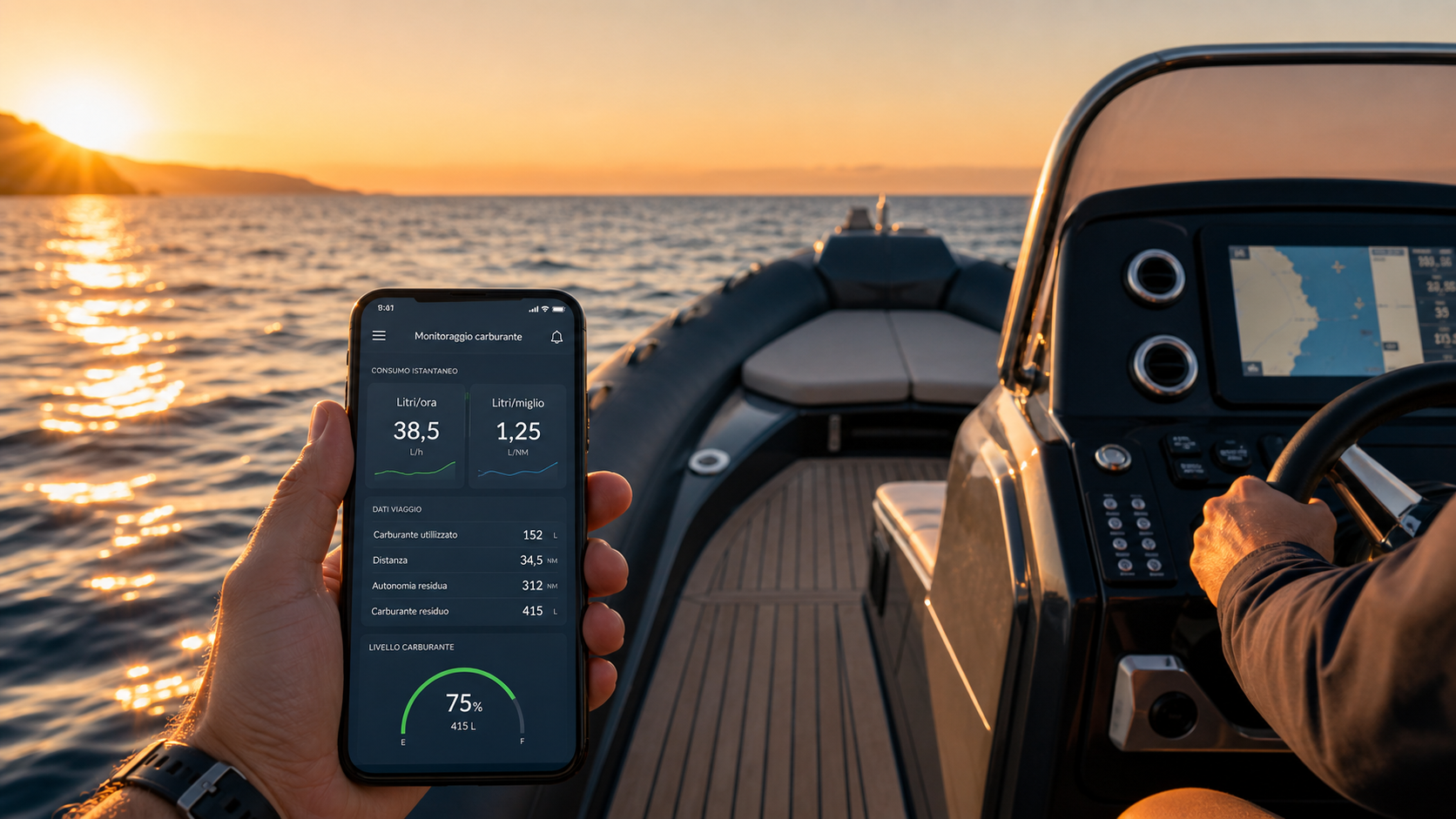
NaviFlow: the marine fuel flow meter for measuring real boat consumption
NaviFlow was created precisely for this purpose: to help boat owners know the real fuel consumption of their boat while cruising.
It is not just an estimate. NaviFlow is a marine fuel monitoring system that displays data such as litres per hour, litres per nautical mile, fuel consumed on a route and other useful information for optimising navigation.
In practice, NaviFlow turns fuel consumption from a hidden figure into visible, useful information.
While cruising, you can immediately understand whether a certain trim adjustment is improving or worsening efficiency. You can see whether a slight increase in speed helps you consume less fuel per nautical mile. You can compare different cruising speeds and find the point where your boat runs best.
This is particularly useful for those who use their boat often, but also for those who only go out a few times a year and want to avoid unnecessary fuel waste.
Why NaviFlow is useful for both petrol and diesel engines
Rising fuel costs do not only affect petrol outboard engines. Diesel boat owners also need to pay close attention to consumption, especially on heavier boats or during longer trips.
For petrol engines, fuel monitoring is useful for checking the consumption of an outboard or inboard engine in real time.
For diesel engines, monitoring is even more interesting because the system often needs to take into account both fuel supply and fuel return. Knowing how much fuel is actually consumed provides far more useful data than simple estimates.
NaviFlow is designed for different engine configurations, both petrol and diesel, and allows you to monitor fuel consumption in a practical way while cruising.
Not only savings: more control also means more safety
Monitoring fuel consumption is not only about spending less. It also helps you navigate with greater peace of mind.
Anyone who goes to sea knows how important it is to know the real range of the boat. Traditional fuel gauges are not always precise, especially with irregularly shaped tanks or when cruising in rough sea conditions.
Knowing how much fuel is being consumed and how much has been used during a route helps you plan trips better, evaluate the return to port and maintain a greater safety margin.
When fuel prices rise, the first thought is usually saving money. But in boating, fuel monitoring is also a matter of awareness, safety and better boat management.
Rising fuel prices: why waiting until refuelling is no longer enough
Many boat owners only discover how much fuel they have consumed when they refuel. But by then it is too late to correct the cruising speed, adjust the trim or understand which part of the trip was least efficient.
With a real-time monitoring system, on the other hand, the data is available while you are navigating.
This allows you to make practical comparisons:
- trim fully down;
- slightly positive trim;
- different cruising speeds;
- different flap settings;
- better weight distribution;
- comparison between calm and rough sea;
- comparison between a light and a fully loaded boat.
In this way, you truly learn how your boat behaves.
The greatest advantage is not only the immediate saving, but the knowledge you gain over time. After a few trips, you know which speed is most efficient, how much your boat consumes in normal conditions and how much each variation affects consumption.
Fuel is more expensive: the solution is to measure better
No boat owner can control the international price of oil. No one can decide the price of fuel at the marina. No one can eliminate the effect of international tensions on energy markets.
What you can do, however, is reduce waste.
In a period when wars, energy crises and global instability make fuel prices more uncertain, knowing the real fuel consumption of your boat becomes a smart choice.
You do not need to give up boating. You need to navigate better.
With NaviFlow, you can understand in real time how much fuel you are consuming, how many litres are needed to travel one nautical mile and which setup provides the best efficiency.
In a context where fuel costs increasingly affect every trip at sea, measuring consumption is no longer optional: it is the first step to saving money, improving range and enjoying boating with greater awareness.
Conclusion
Rising fuel prices also affect recreational boating. Every boat trip can now cost more, especially if you do not know the real fuel consumption of your boat.
International tensions, the war in Ukraine, the crisis in the Middle East and instability in energy markets have made fuel prices more variable and less predictable. This is why it is increasingly important to focus on what you can control: the way you navigate.
NaviFlow allows you to monitor your boat’s fuel consumption in real time, identify the most efficient cruising speed and reduce unnecessary fuel waste.
If fuel prices rise, the best response is to have more control.
Discover NaviFlow and start monitoring your boat’s fuel consumption in a precise, simple and immediate way.
Useful sources:
Italian Ministry of Enterprises and Made in Italy - Average fuel prices: https://www.mimit.gov.it/it/prezzo-medio-carburanti/regioni
Council of the European Union - Impact of the war in Ukraine on markets: https://www.consilium.europa.eu
NaviFlow: https://www.naviflow.it/en/marine-flow-meter