


Marine fuel flow meter: simple installation and real-time boat fuel consumption monitoring
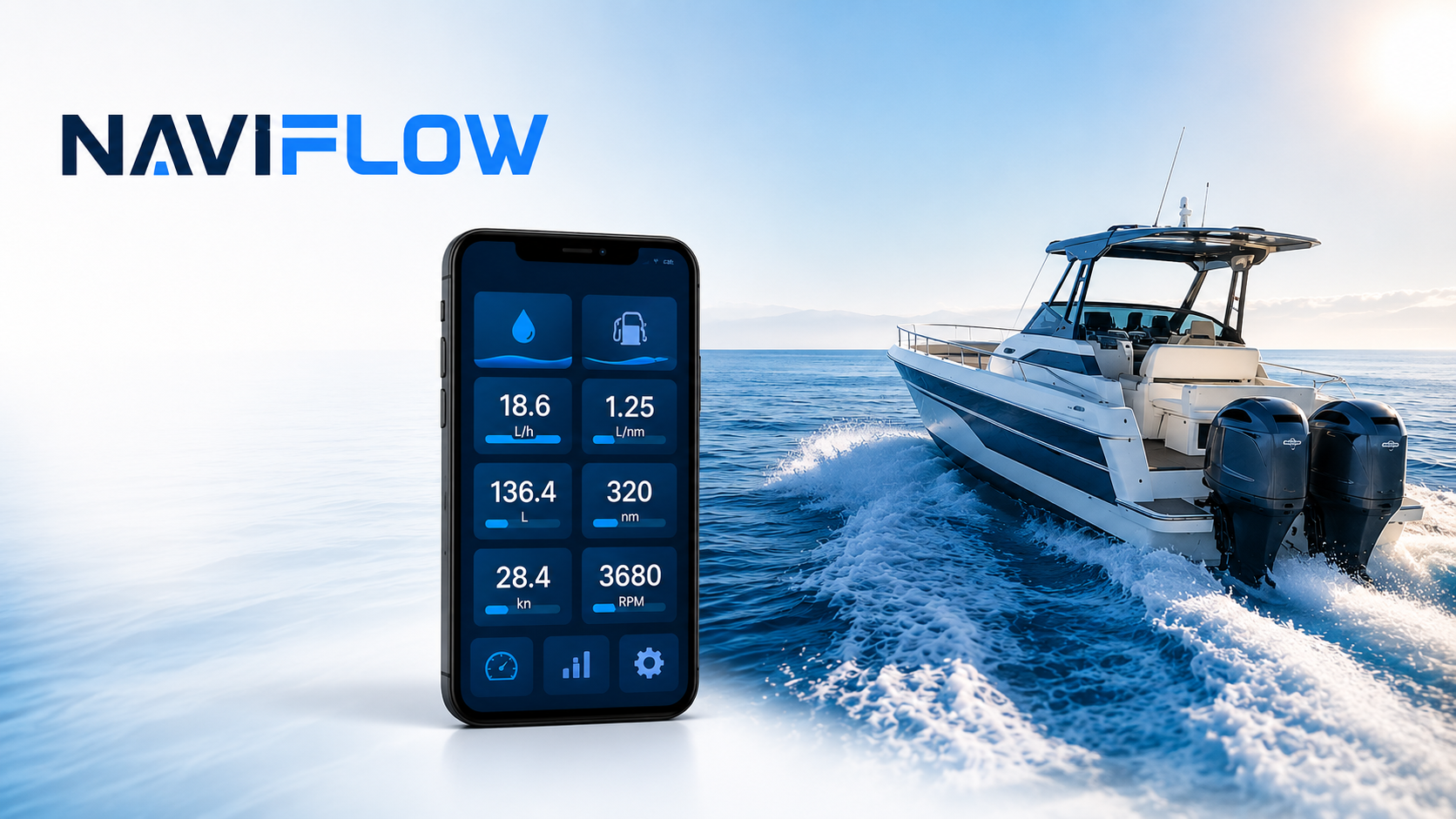
A marine fuel flow meter is an essential tool for anyone who wants to know the real boat fuel consumption during navigation. Knowing how many litres per hour your engine consumes, how many litres are needed to travel one nautical mile and how much fuel has been used on a route allows you to navigate in a more informed, efficient and safe way.
With NaviFlow, you can monitor your boat’s fuel consumption in real time through the app, without invasive installation on the console and without adding complex instruments to the helm. The system is designed for boats with one or two engines, is suitable for both petrol and diesel engines, and can be used on outboard, inboard and sterndrive configurations.
What is a marine fuel flow meter?
A marine fuel flow meter is a device that measures the fuel passing through the engine’s fuel supply circuit. This makes it possible to know exactly how much fuel the boat consumes during each phase of navigation and to evaluate the effect of changes in trim, speed, load and performance.
This type of device is also commonly searched for as:
- boat fuel consumption meter
- marine econometer
- boat fuel meter
- marine flow meter
- litres per hour boat meter
- boat fuel consumption monitoring system
The main advantage is simple: instead of relying on rough estimates or only on the fuel gauge, you can count on real, immediate data. This helps you understand how to improve fuel efficiency and keep the cost of every trip under control.
Why install a fuel flow meter on your boat?
Monitoring fuel consumption in real time helps you make better decisions while cruising. Even small changes in trim, flaps, engine height, propeller choice or weight distribution on board can have a significant impact on final fuel consumption.
With a system like NaviFlow, you can immediately check the effect of these changes and understand which configuration makes your boat more efficient. This means reducing waste, improving range and gaining better control over fuel costs.
The system can also help identify unusual situations. A sudden increase in fuel consumption may be a sign of an installation issue, incorrect weight distribution, a dirty hull, an unsuitable propeller or an engine setup that is not optimised.
What you can monitor with NaviFlow
The NaviFlow system allows you to display several useful data points for navigation and boat management:
- real-time fuel consumption
- litres per hour
- litres per nautical mile
- fuel used
- remaining fuel in the tank
- estimated range
- annual fuel consumption
- route recording
- cost of each route
- total cost at the end of navigation
Routes can be saved with their navigation data and fuel cost. This is especially useful for those who want to analyse fuel consumption over time or accurately share the fuel expenses of a day at sea with friends or family.
Litres per hour and litres per nautical mile: why these figures matter
The litres per hour value shows how much fuel the engine is consuming at that specific moment. It is a useful figure for understanding instant consumption, but on its own it is not always enough to evaluate the real efficiency of navigation.
The litres per nautical mile value helps you understand how much fuel is needed to cover a certain distance. This figure is extremely important because it helps identify the most efficient cruising speed, meaning the best balance between speed, consumption and range.
Sometimes cruising slightly faster can be more efficient than cruising too slowly, especially if the boat struggles to stay on plane. Without real data, this is difficult to notice. With NaviFlow, you can compare different cruising speeds and understand which setup really reduces consumption.
Marine fuel flow meter for single-engine and twin-engine boats
NaviFlow is available for boats with a single engine or twin engines. In the Twin Engine version, each engine can be monitored separately in real time, providing more precise and complete control over the boat’s behaviour.
This makes it possible to compare the consumption of the two engines, check for performance differences and improve the overall efficiency of the boat. In a twin-engine setup, separate engine data can also help detect anomalies or operating differences.
Compatible with petrol and diesel engines
The system is suitable for both petrol and diesel engines, including outboard, inboard and sterndrive configurations. This versatility makes NaviFlow a suitable solution for many types of boats, RIBs and recreational vessels.
In diesel versions, the control unit is equipped with two flow meters: one for the fuel supply and one for the fuel return. This allows the system to correctly calculate real consumption even on engines where unused fuel returns to the tank.
How to install a marine fuel flow meter
The NaviFlow marine fuel flow meter has been designed for simple, fast and minimally invasive installation. There is no need to drill the console and no need to run complex new cables to the helm. This makes the system practical even on boats where the onboard instrumentation needs to remain clean and tidy.
1. Powering the control unit
The first step is to power the control unit by connecting it to the boat’s electrical system. NaviFlow works with 12 V or 24 V power supply, so it can be easily integrated on most boats.
Once the power supply is connected, the control unit is ready to communicate with the system and collect consumption data from the flow meter.
2. Connecting the flow meter to the fuel hose
The flow meter is installed on the fuel hose, at the correct point in the fuel supply circuit. This step is essential because the sensor must accurately measure the fuel flow going to the engine.
For correct installation, it is important to:
- respect the flow direction indicated on the sensor
- use compatible fittings and tighten them properly
- avoid bends or abnormal tension on the fuel hose
- secure the flow meter firmly
- always check for fuel leaks after installation
In the case of diesel engines, as mentioned above, the system uses two flow meters to correctly manage fuel supply and return.
3. Activating Bluetooth on your smartphone
After connecting the control unit and installing the sensor on the fuel circuit, simply activate Bluetooth on your smartphone. This allows the NaviFlow app to communicate with the system without the need to install additional displays or wiring on the console.
To learn more about how the app works, you can read the page dedicated to the marine app for boat fuel consumption , available for iOS and Android devices.
4. Opening the NaviFlow app
Once Bluetooth is enabled, simply open the NaviFlow app on your iOS or Android smartphone. In just a few moments, the system is ready to display fuel consumption data and the main navigation information.
Using the system through the app makes everything intuitive and immediate. All data is easy to view and always available while cruising.
5. Initial system configuration
Once the device is connected, you can complete the initial configuration according to your boat. At this stage, you can set the engine type, the number of engines and the main parameters needed for accurate consumption readings.
After this initial setup, the system is ready to use and can immediately provide useful information to improve the boat’s efficiency.
6. Optional NMEA 2000 connection
For users who want to integrate the marine fuel flow meter with onboard electronic instruments, NaviFlow is also available with an optional NMEA 2000 output. This solution allows the system data to be sent to compatible devices and improves integration with the electronics already installed on board.
To better understand what this standard is and how it works, you can also read our article about NMEA 2000 .
Watch the installation video
To see a practical example, you can watch the NaviFlow installation video on a Honda BF200 outboard installed on a CAD22 WA. The video helps you better understand how simple the installation is and the advantages of the system during navigation.
Questions a marine fuel flow meter helps you answer
Every careful boat owner asks practical questions before, during and after navigation. A system like NaviFlow helps answer them with accurate data, such as:
- How much fuel does my outboard, inboard or sterndrive engine really consume?
- What is the best cruising speed to reduce fuel consumption?
- Is my propeller suitable for my boat setup?
- Is the weight on board correctly distributed?
- How much did I spend on the last route?
- How much petrol or diesel is left in the tank?
- How much fuel did I use during the whole season?
Having this information in real time changes the way you navigate, because it allows you to make better decisions and reduce waste without relying on guesswork.
How much fuel does a boat consume?
There is no single answer that applies to every boat, because fuel consumption depends on many factors: engine type, weight on board, trim, speed, sea conditions, propeller, trim adjustment and the general configuration of the boat.
This is exactly why a marine fuel flow meter is so useful. Instead of relying on theoretical or generic values, you can know the real fuel consumption of your boat in every situation. This allows you to understand precisely which cruising speed is more convenient and which setup offers the best balance between performance and fuel saving.
Why choose NaviFlow
- real-time fuel consumption monitoring
- simple and fast installation
- no console drilling or complicated cable routing
- Bluetooth connection with dedicated app
- support for petrol and diesel engines
- versions for one or two engines
- route saving, fuel consumption and remaining tank data
- calculation of the cost of each route
- optional NMEA 2000 connection
Discover NaviFlow and start monitoring your boat’s fuel consumption in real time.